Arc de Triomphe Guide: 10 Things Not to Miss + Tickets & Tips

Standing 50 meters tall at the top of the Champs-Élysées, the Arc de Triomphe is the beating heart of French national pride. Napoleon commissioned it in 1806 after his victory at Austerlitz, but he died before it was finished in 1836. His funeral procession still passed beneath it in 1840, en route to Les Invalides. The views from the rooftop are still some of my absolute favorites in all of Paris.
Today, it’s where France celebrates victories, mourns losses, and marks historic moments. The Tour de France ends here. Bastille Day parades begin here. And beneath it burns an eternal flame that’s never been extinguished—not even during Nazi occupation.
The Basics
Address: Place Charles de Gaulle, 75008 Paris
Metro: Charles de Gaulle-Étoile (Lines 1, 2, 6, RER A)
Hours:
- April 1-Sept 30: 10am-11pm (Tuesdays from 11am)
- Oct 1-March 31: 10am-10:30pm (Tuesdays from 11am)
- Last entry 45 minutes before closing
Tickets:
- €16 (standard rate Oct-March, Wednesdays during high season)
- €21-22 (June-Sept, except Wednesdays)
- Free: Under 18, EU residents 18-25, first Sunday of every month Nov-March
- Book online to skip ticket lines
Closed:
January 1, May 1, May 8 (morning), July 14 (morning), November 11 (morning), December 25
Getting There:
Never try to cross the roundabout on foot! It’s twelve lanes of Parisian traffic with zero regard for pedestrians. Use the underground passage accessed from the Champs-Élysées (Avenue side) or Avenue de la Grande-Armée.
The Climb:
284 steps total. No public elevator (wheelchair users can access the museum level only, not the rooftop). Budget 40-60 minutes for your visit.
10 Things Not to Miss
1. La Marseillaise Sculpture
The most famous of the four massive relief sculptures, carved by François Rude on the right pillar facing the Champs-Élysées. A winged Liberty leads volunteers marching off to defend France in 1792. The passion, movement, and raw energy jumping off the stone is extraordinary. This is the sculpture that defined French patriotism—its face even appears on the belt buckle for Marshals of France.
2. The Names on the Walls
Step inside the arch and look up. All four interior walls are engraved with 660 names—generals and battles from the Revolutionary and Napoleonic Wars. Notice the underlined names? Those generals died in battle. It’s like reading France’s military history in stone.
3. Eternal Flame Ceremony at 6:30pm
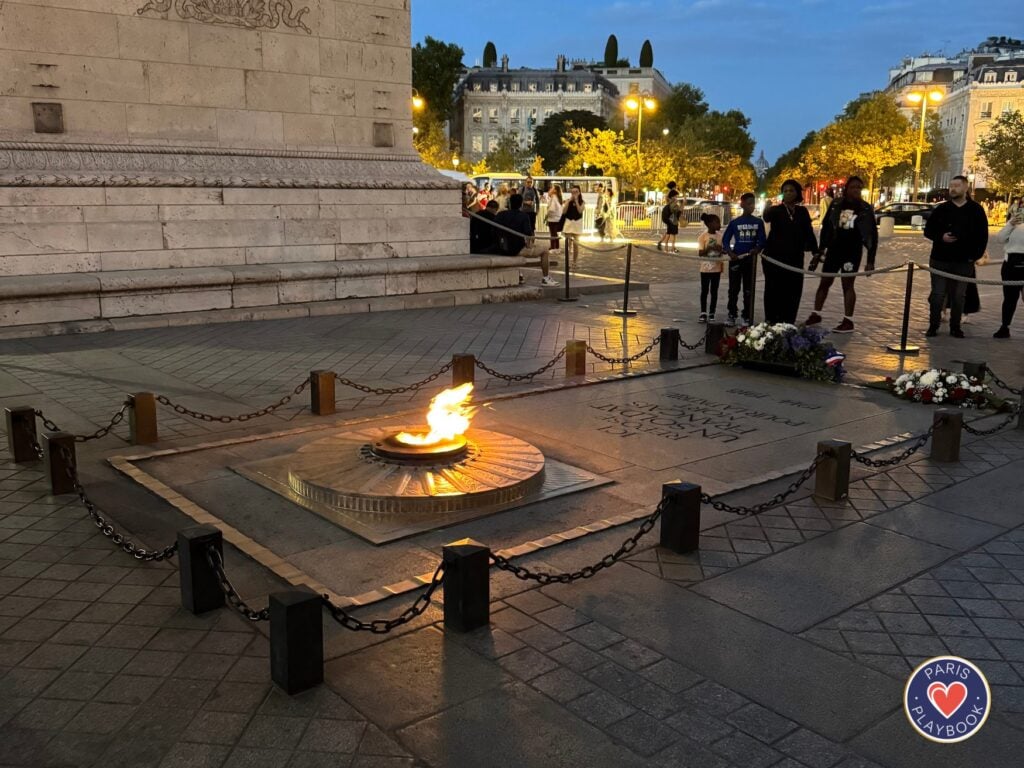
Every evening at 6:30 pm, members of French veterans associations rekindle the flame at the Tomb of the Unknown Soldier. It’s been done daily since 1923—through occupation, liberation, peace, war. Even the Nazis allowed it to continue. Stand quietly and watch. It takes about 15 minutes, and it’s one of the most moving rituals in Paris.
4. The 360° Rooftop View
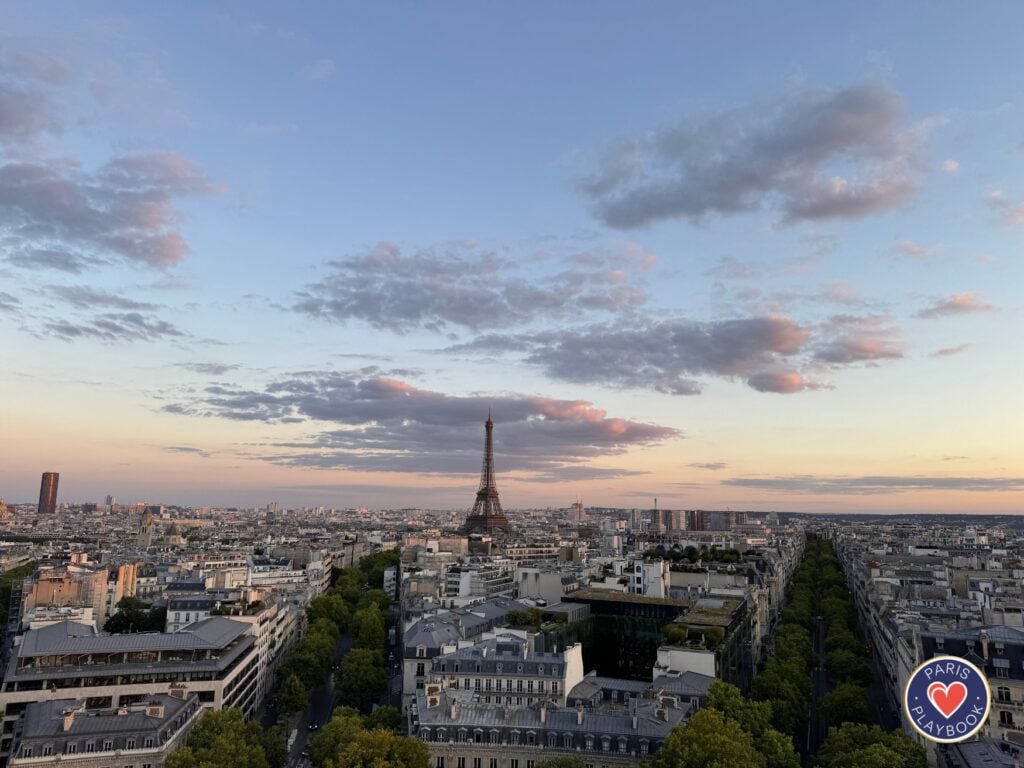
This is why you climbed 284 steps. From the top, you see exactly why this location matters: twelve avenues radiating outward like a star (hence the original name, Place de l’Étoile). Spot the Eiffel Tower, Sacré-Coeur, La Défense, and the entire Axe Historique stretching from the Louvre through Place de la Concorde to the modern Grande Arche. Digital tablets up here identify over 20 monuments. Go at sunset if you can—the light on Haussmanian rooftops is spectacular.
5. The Four Sculptural Groups
Each massive pillar features a different sculptural group telling France’s story:
- La Marseillase (Rude): Volunteers of 1792 heading to war
- The Triumph of 1810 (Cortot): Napoleon at his peak, celebrating victories and his marriage to Marie-Louise
- Resistance of 1814 (Étex): France fighting foreign invasion as the Napoleonic Empire crumbled
- Peace of 1815 (Étex): The return to agriculture and prosperity after war
Walk around the entire base. Each one deserves attention.
6. The Tomb of the Unknown Soldier
Beneath the arch lies an unidentified French soldier from World War I, buried here on Armistice Day 1920. He represents all those who died unnamed, unclaimed, unidentified. The tomb is engraved with “Ici repose un soldat français mort pour la patrie 1914-1918” (Here lies a French soldier who died for the homeland). Jackie Kennedy visited in 1961 with JFK and later requested an eternal flame for her husband’s grave at Arlington, inspired by this one.
7. The Relief Panels
Six relief panels carved into the arch’s façades depict specific battles and moments:
- Battle of Austerlitz
- Battle of Aboukir
- Crossing of Arcole Bridge
- Capture of Alexandria
- Funeral of General Marceau
- Battle of Jemmapes
The detail is incredible—horses mid-charge, soldiers in combat, commanders directing troops. This is storytelling in limestone.
8. The Museum Level
Halfway up (accessible by elevator for those with mobility issues), a small museum tells the arch’s history through artifacts, drawings, and multimedia displays. See original construction plans, learn about the sculptors, understand why it took 30 years to build. It’s easy to skip this—don’t. It adds crucial context to what you’re seeing.
9. The Coffered Vault and Inscriptions
Look up at the underside of the main vault. It’s covered in detailed coffers (recessed panels) carved with the names of 128 battles and major victories. The artistry on something most people never notice is typical Paris—beauty in every detail, whether you’re looking or not.
10. The Perspective Down the Champs-Élysées
Before you leave, stand on the Champs-Élysées side and look back toward Place de la Concorde. This view—tree-lined avenue, the Obelisk in the distance, the arch framing it all—is one of the most iconic in Paris. It’s the shot you’ve seen a thousand times, but standing here, you understand why it never gets old.
Insider Tips

Best time to visit: Weekday mornings right at opening (10am), or after 8pm when day-trippers have left. Weekends and midday are packed.
Sunset timing: In summer, sunset views are magical but it’s crowded. Winter sunsets happen earlier and the cold keeps crowds thin.
Photography: The rooftop has 360° access with no obstructions. Wide-angle lens helps. The golden hour (hour before sunset) makes everything glow.
Respect the space: This is an active war memorial. Keep voices low near the tomb, don’t walk across the eternal flame area, and dress respectfully.
Combo it: The Arc is part of the Paris Museum Pass. If you’re seeing multiple monuments, it’s worth it. You still need to book a time slot online even with the pass.
Skip the ticket line: Book online even if it’s not timed entry. The “reserved entry” line on the right side of the arch moves much faster than the ticket purchase line.
Accessibility note: Wheelchair users can access the museum level via elevator but cannot reach the rooftop (requires climbing 42 additional steps from the museum level).
Don’t miss the underpass: The pedestrian tunnel connecting to the arch also has historical displays and gives you a sense of scale before you emerge at the base.
Why It Matters

The Arc de Triomphe is more than Instagram fodder. It’s where French national identity crystallizes into stone. Every major French celebration or mourning passes through here. When Paris liberated itself in 1944, this is where they gathered. When the nation grieves, this is where they come.
Napoleon wanted a monument to French military glory. He got that, but also something deeper—a place where France recognizes sacrifice, honors the fallen, and reminds itself what it fought for. The soldiers who never came home have a place here. The flame that never dies says: we remember.
Plus, the view from the top is absolutely stunning.